
Introduction
The Great Migration in Serengeti National Park is widely considered one of the greatest wildlife spectacles on the planet.
Every year millions of animals move across the vast plains of the Serengeti ecosystem searching for fresh grass and water.
This incredible journey has taken place for centuries and continues to shape the natural balance of the ecosystem.
Because of its scale drama and beauty the migration attracts wildlife lovers photographers and scientists from around the world.
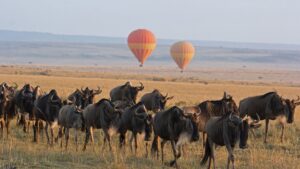
Millions of Animals on the Move
The migration is mainly led by wildebeests which travel in enormous herds across the Serengeti plains.
More than two million wildebeests participate in this journey accompanied by hundreds of thousands of zebras and gazelles.
These animals move together across the landscape while following seasonal rainfall patterns that determine grass growth.
As a result the migration route changes slightly every year depending on the location of fresh grazing areas.
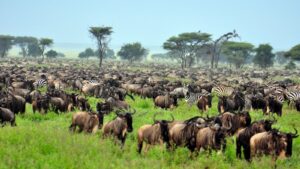
The Calving Season in Southern Serengeti
The migration cycle usually begins in the southern plains of the Serengeti where calving season takes place.
Between January and March thousands of wildebeest calves are born within a very short period.
This event creates one of the highest concentrations of newborn animals found anywhere in the natural world.
However predators such as lions cheetahs and hyenas are quickly attracted to this area.
The Journey Toward the North
When the dry season begins the grass in southern Serengeti gradually disappears.
Consequently the herds begin moving northward toward greener regions in search of food and water.
During this journey massive lines of animals stretch across the plains creating unforgettable scenes for safari visitors.
Predators follow closely behind the migrating herds creating dramatic interactions between hunters and prey.
The Mara River Crossing
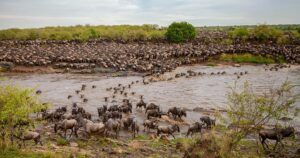
One of the most dramatic moments of the migration occurs when animals reach the Mara River.
Thousands of animals gather along the riverbanks waiting for the right moment to cross the dangerous waters.
Eventually one animal jumps into the river and the rest of the herd quickly follows.
Crocodiles wait patiently in the water while chaos unfolds during the crossing.
The Endless Natural Cycle
After reaching the northern regions the herds slowly begin moving back toward the southern Serengeti plains.
This return journey is guided by seasonal rainfall and the growth of new grass across the ecosystem.
Eventually the animals return to the southern plains where the cycle begins once again.
Therefore the Great Migration continues every year as one of nature’s most remarkable survival stories.
Conclusion
The Great Migration in Serengeti National Park remains one of the most extraordinary wildlife events on Earth.
Millions of animals participate in this natural journey across the landscapes of Tanzania each year.
For travelers visiting the Serengeti witnessing this incredible movement of wildlife becomes an unforgettable safari experience.